- Deal Lift
- Posts
- From Gin & Tonics to a $2.1B Exit: The KAYAK Founder Playbook
From Gin & Tonics to a $2.1B Exit: The KAYAK Founder Playbook
How Steve Hafner and Paul English turned travel frustration into a $2.1 billion acquisition by building the simplest UI layer on top of messy legacy systems — and what you can steal for your startup

Deal Lift
November 09, 2025
In partnership with

👋 Hey Deal Lift Crew
Today, we’re diving into the story of KAYAK — a company born from a late-night meeting over drinks, built on simplicity, and grown into a $2.1 billion exit. For founders building in tech, marketplaces, or layering on top of legacy problems, this one’s packed with tactical insights. Let’s get into it.

🧠 The Spark: Not Reinventing Travel — Simplifying It
In the early 2000s, Steve Hafner, co-founder of Orbitz, noticed an infuriating truth: about 70% of users would search for flights on Orbitz… then leave to book directly with the airline. The leads were there — the revenue wasn’t.
Meanwhile, Paul English, a serial entrepreneur fresh off a sale to Intuit, was looking for his next challenge. A chance meeting at Legal Sea Foods in Harvard Square over gin and tonics turned into a handshake partnership.
Within an hour, KAYAK was born — two operators obsessed with cutting through noise and simplifying travel.
They launched in January 2004, investing $1 million each. By August, they’d bought the domain kayak.com for $30,000 — one of the best startup buys in internet history.
Core insight: Sometimes innovation isn’t invention. It’s simplification. They didn’t build a new travel engine — they built a better experience.
Missed OpenAI? The Clock Is Ticking on RAD Intel’s Round

Ground floor opportunity on predictive AI for ROI-based content.
RAD Intel is already trusted by a who’s-who of Fortune 1000 brands and leading global agencies with recurring seven-figure partnerships in place.
$50M+ raised. 10,000+ investors. Valuation up 4,900% in four years*.
Backed by Adobe and insiders from Google. Shares at $0.81 until Nov 20 — then the price moves. Invest now.
This is a paid advertisement for RAD Intel made pursuant to Regulation A+ offering and involves risk, including the possible loss of principal. The valuation is set by the Company and there is currently no public market for the Company's Common Stock. Nasdaq ticker “RADI” has been reserved by RAD Intel and any potential listing is subject to future regulatory approval and market conditions. Investor references reflect factual individual or institutional participation and do not imply endorsement or sponsorship by the referenced companies. Please read the offering circular and related risks at invest.radintel.ai.
🏗️ Execution Timeline: Build → Grow → Exit
Year | Milestone | Why it mattered |
|---|---|---|
2004 | KAYAK was founded; each founder invested $1M | Started strong and self-funded to prove conviction. |
2005 | Public launch; fast, clean, clutter-free interface | Nailed product-market fit through simplicity. |
2007 | Raised $196 M to expand rapidly | Backed by top investors to dominate early. |
2012 | IPO in July; stock pops 30% first day | Validation that the “meta-search” model worked. |
2013 | Acquired by Priceline (Booking Holdings) for $2.1 B | Major exit; kept its brand and independence post-deal. |
🔑 Why KAYAK Worked
1. 🧭 Solved One Real Problem — Seamlessly
Travelers didn’t want more features; they wanted clarity. KAYAK aggregated every flight, hotel, and rental in one view — no fluff, just answers.
2. 🧩 Leveraged, Don’t Rebuild
Instead of building its own inventory, KAYAK acted as a “thin layer” on top of existing systems — scraping data, licensing feeds, and focusing on interface + brand. That lean approach meant faster launches and less infrastructure drag.
3. 💰 Smart Timing for Capital
After validating demand, they raised a $196M round to outspend competitors like Expedia and Orbitz in marketing, product, and partnerships. Timing was perfect — right before travel tech consolidation.
4. 🌎 Simple Product → Global Brand
Their site became synonymous with ease. KAYAK didn’t shout; it simplified. That UX-first mindset made them the “Google of travel search.”
⚙️ Tactical Breakdown — What Founders Can Steal
Don’t over-engineer the stack. Be the best experience layer, not the biggest infrastructure builder.
Find the leak in your industry. 70% of Orbitz users leaving? That’s where KAYAK made its kill.
Launch with clarity. MVPs don’t have to look fancy; they just need to work beautifully.
Use capital to scale, not to start. Validate first, then raise big.
Plan exits early. KAYAK always knew integration with a major travel network was its best endgame.
📊 Extra Insights You Might’ve Missed
The acquisition by Priceline (now Booking Holdings) let KAYAK tap into a massive distribution ecosystem — but it stayed operationally independent to preserve its culture.
KAYAK’s marketing wasn’t loud; it was clever. They ran ads emphasizing how stupid it was to use multiple sites. It worked.
Their tech advantage came from partnering with ITA Software (the same company Google later bought to power Google Flights).
By 2012, KAYAK processed over 100 million flight searches per month — showing that aggregation done right scales like crazy.
💥 The Power of the “Layer Strategy”
Here’s why this model still works today:
High leverage: You don’t need to own every asset — just the interface users love.
Low CapEx: Build on top of legacy players who already spent billions on infra.
Scalable defensibility: Once users associate your brand with “clarity,” they’ll stay.
Exit-ready: Acquirers love efficient layers — they bolt on easily and expand reach.
Modern parallels?
Zapier layered over APIs.
Plaid layered over banks.
TripActions (Navan) layered over corporate travel software.
The playbook is timeless.
🧠 Founder Lessons
Innovation = simplification. Don’t overcomplicate.
Solve leaks. Watch where users drop off — plug it.
Small team, massive clarity. In the early years, KAYAK ran lean and focused on one metric: conversion.
Strategic exit ≠ surrender. Selling to Booking wasn’t an end — it was a growth accelerator.
📈 The Infinite Game
When Steve Hafner sold KAYAK, he didn’t stop. He went on to lead OpenTable, applying the same “simplify the experience” principle to dining reservations. Paul English later co-founded Lola.com, another travel startup, proving the mindset lasts longer than the product.
Both founders understood this truth:
Building is never one and done. It’s an infinite game.
✨ Deal Lift Takeaways
💡 Find inefficiencies. They’re often billion-dollar opportunities hiding in plain sight.
🚀 Simplify before scaling. The cleanest product wins.
🤝 Partnerships > ownership. Use others’ infrastructure to move faster.
🧱 Build for leverage. When your product becomes the layer, you control the funnel.
💵 Plan your outcome. IPOs, acquisitions, or reinvention — success has stages.
The Simplest Way To Create and Launch AI Agents
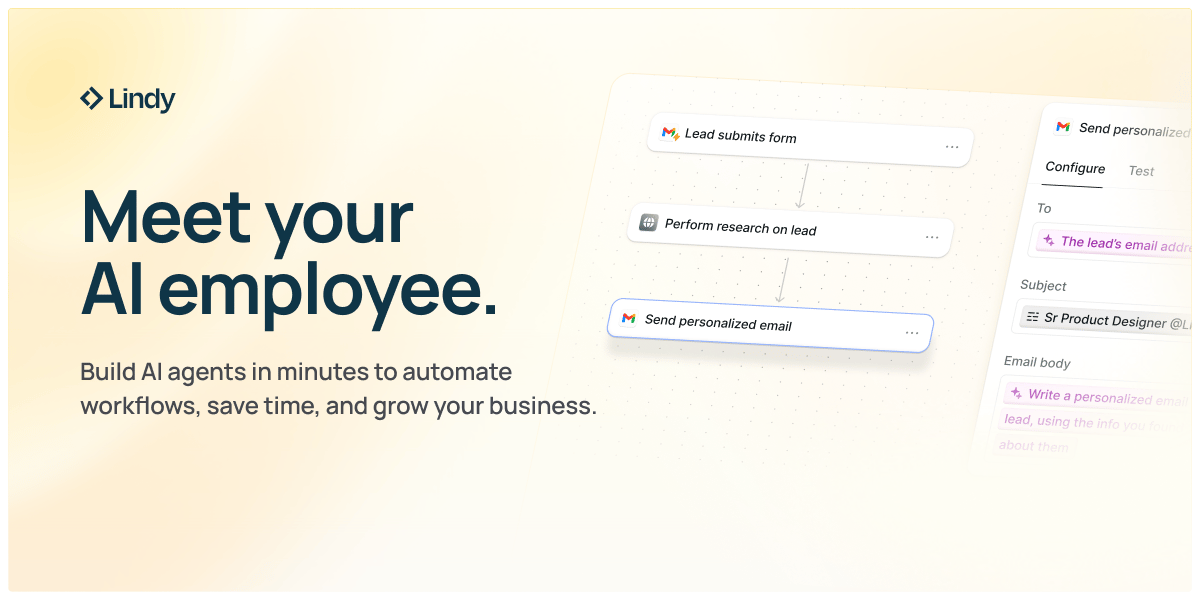
Imagine if ChatGPT, Zapier, and Webflow all had a baby. That's Lindy.
With Lindy, you can build AI agents and apps in minutes simply by describing what you want in plain English.
From inbound lead qualification to AI-powered customer support and full-blown apps, Lindy has hundreds of agents that are ready to work for you 24/7/365.
Stop doing repetitive tasks manually. Let Lindy automate workflows, save time, and grow your business.
See you in the next issue of Deal Lift — where founders study founders, and stories turn into strategies.